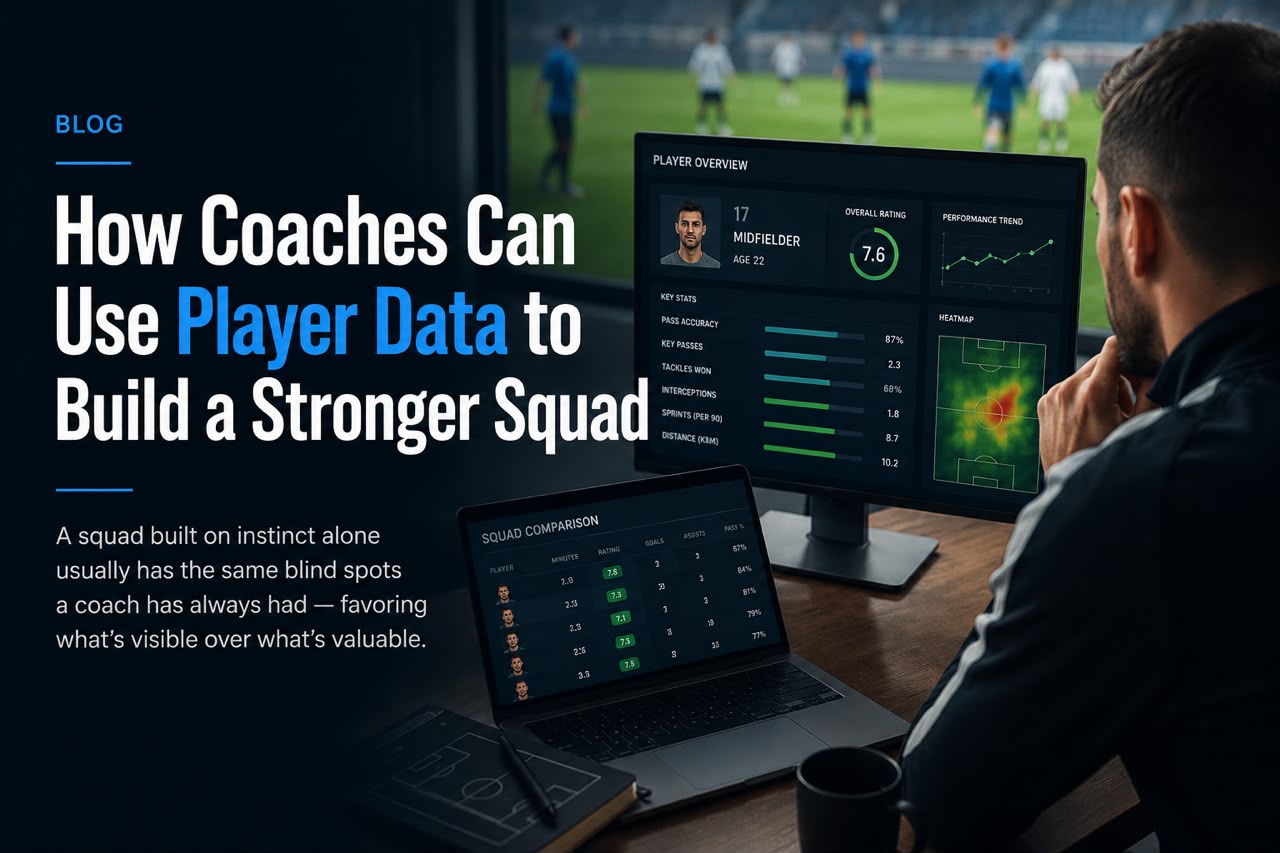
How Coaches Can Use Player Data to Build a Stronger Squad
April 23, 2026 • 136 views
A squad built on instinct alone usually has the same blind spots a coach has always had, favoring certain physical traits, certain playing styles, or certain backgrounds, regardless of whether those traits are what the team actually needs. Player data exists to correct for that bias, not replace coaching judgment.
The most effective use of data isn't predicting who will become a star. It's identifying gaps in a squad's structure that aren't obvious from watching matches alone a lack of depth at a specific position, an over-reliance on one or two players for goal contributions, or a defensive line that performs well individually but poorly as a unit.
Where Data Adds the Most Value
Squad balances over individual brilliance. Watching matches tends to highlight standout individual moments. Data is better at revealing structural issues for example, a team that creates plenty of chances but converts poorly, or a midfield that wins possession but loses it quickly in transition. These patterns are far easier to spot in aggregated data than in match-by-match observation.
Identifying replacement need before it becomes urgent. Tracking minutes played, injury history, and contract status across a squad allows a coach to flag positions that will need reinforcement before the gap becomes a crisis rather than scrambling during a transfer window after an injury or departure.
Comparing trial players against existing squad benchmarks. Rather than judging a trialist purely on a single session, comparing their output against the statistical profile of players already performing well in that position gives a far more objective read on fit.
What Data Shouldn't Replace
Data doesn't capture attitude, coachability, or how a player responds under pressure in a way that matters to a specific dressing room. A player who looks ideal statistically can still be a poor fit for a squad's culture. The strongest approach treats data as a filter that narrows options, with final decisions still resting on direct observation and conversation.
A Practical Starting Point for Coaches
Coaches don't need a full analytics department to start. Tracking even three or four metrics consistently, goals/assists per 90 minutes for attackers, duels won and interceptions for defenders, pass completion under pressure for midfielders, and minutes played across the squad, is enough to start spotting patterns that pure observation misses.
FAQ
Do smaller clubs without analytics staff have access to useful player data? Yes. Platforms built for scouting and recruitment now surface position-relevant stats directly on player profiles, without requiring a dedicated analytics department.
What's the biggest mistake coaches make when using data? Treating a single strong statistic as proof of overall quality, without checking it against the context level of competition, role within the team, and sample size.
How much data is actually needed to make a good recruitment decision? A small number of position-relevant metrics, tracked consistently over a full season, is usually more reliable than a large volume of metrics from a handful of matches.
FutbolConect's performance dashboards give coaches a clear view of player and squad data in one place, making it easier to spot gaps, evaluate trialists, and build a squad based on more than just what's visible from the touchline.